The Thematic Apperception Test (TAT) is the longest and most revealing psychology test in the SSB — 11 ambiguous pictures plus 1 intentionally blank slide, with 30 seconds to observe each picture and 4 minutes to write a short story. Assessors read all 12 stories together to decode your inner personality against the 15 Officer Like Qualities (OLQs). This guide covers the framework, the common mistakes, and gives you 5 complete stories to model.
What the TAT actually measures
A TAT picture is deliberately ambiguous — a man near a window, a group by a river, a child alone on a road. Different candidates project very different stories onto the same image, and that projection is what the assessors analyse. They map your stories to markers like:
Effective Intelligence — does your hero use resources at hand, or wish for miracles?
Reasoning Ability — does the story flow logically from cause to action to outcome?
Initiative — does your hero act, or wait for someone else to act?
Determination — does the hero see the problem through, even when it becomes difficult?
Power of Expression — is the story clear, grammatical, and vivid without being flowery?
The 4-part story framework
Hero — pick a realistic protagonist within a couple of years of your own age and same gender. Give a name and a one-line background (student, engineer, farmer, cadet).
Trigger & Problem — one sentence explaining what led up to the picture. Keep the problem small, real, and clearly solvable within the story window.
Action — two or three specific, practical steps your hero takes. Prefer coordination and initiative over lone heroism. Show effort spread over hours, days, or weeks — not seconds.
Outcome — a positive but believable ending. Avoid perfect miracles and avoid endings where "everyone lived happily ever after" — assessors want honest resolution.
Common mistakes that lower your TAT score
Super-hero fiction — one person single-handedly saving a village, defeating an army, or winning a national prize.
Political, religious, or violent themes — controversial content of any kind is a red flag.
Supernatural elements — no ghosts, magic, prophecies, or divine intervention.
Passive heroes — the hero waits, hopes, or asks fate to intervene.
Bookish morals — closing lines like "the moral of the story is…" or "hard work always wins".
Overshooting the time — writing more than one full page, so slide 12 gets rushed or skipped.
Recycled coaching templates — assessors read hundreds of stories; identical structures stand out immediately.
How to handle different picture types
Hazy / low-detail slides
Do not spend 20 of your 30 observation seconds squinting. Pick the one or two elements you can see clearly (a figure, a doorway, a road) and build the story around them.
Dark or ominous slides
Do not force a violent or tragic interpretation just because the picture looks gloomy. A dim room can be a student studying late, a doctor on night duty, or a soldier on a routine patrol.
Group scenes
Choose one hero and mention the others by role, not by name — "his sister", "the team captain", "the villagers". A group scene is a chance to show cooperation and leadership.
The blank 12th slide
The blank slide is the assessor's clearest window into your natural mind, because you invent both picture and story. Pick a real recent situation from your own life (studies, family, sports, workplace) and write it out in the same 4-part framework — hero, problem, action, outcome. Do not describe an epic; describe a normal day where you or someone like you did something practical.
5 sample TAT stories
These are illustrative — do not memorise them. The point is to internalise the rhythm: a realistic hero, a small problem, clear actions, and a believable, positive outcome. Each story is short enough to write in the 4-minute window.
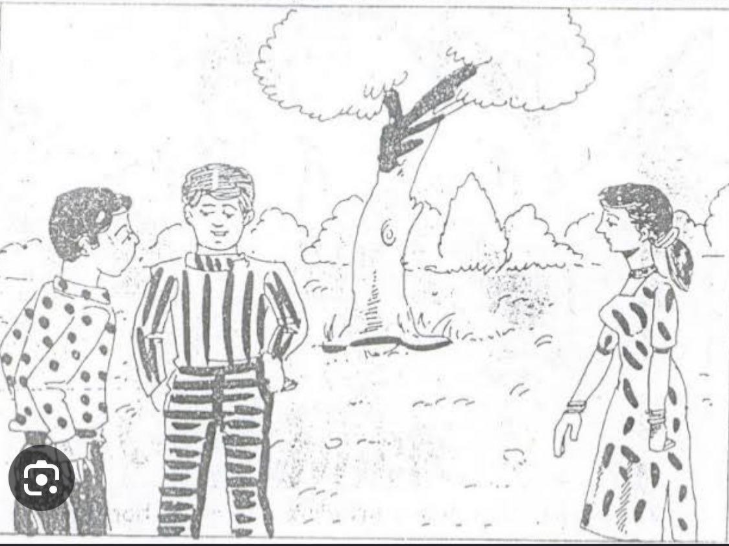
Three young people talking outdoors under a large tree.
Hero: Karan, 21, second-year college student
Problem: Home in his village for the summer break, he learns that many local children have fallen months behind in school after a health scare shut the school for weeks.
Action: He meets his two closest friends under the old neem tree, agrees to run free evening classes at the community hall, splits subjects between the three of them, prints simple flyers, and enrols 22 children in the first week.
Outcome: By the end of the break every child clears the term test. The village pradhan invites the three of them back for the winter break to expand the programme.
Read the full 4-minute story
"Karan, 21, a second-year college student, returns to his village for the summer break and learns that many children have fallen months behind after a health scare closed the school. He meets his two closest friends under the old neem tree and proposes free two-hour evening classes at the community hall. They split subjects between them, print simple flyers, and enrol twenty-two children in the first week. By the end of the break every child clears the term test, and the village pradhan invites them back for the winter to expand the programme."
A young man at a police station counter facing a uniformed inspector on duty.
Hero: Vikram, 23, MBA student
Problem: On his way home from a late class he witnessed a chain-snatching outside an elderly neighbour's house in his colony, and noted the miscreant's motorcycle number and clothing before the culprit sped away.
Action: He calmed the elderly victim, walked with her to the nearest police station within twenty minutes, gave a detailed statement to the duty inspector including the motorcycle number, and helped her draft the FIR.
Outcome: The police recovered the chain from a local scrap dealer within two days. The colony welfare association thanked Vikram at their next meeting and installed CCTV cameras at the entry gate the following month.
Read the full 4-minute story
"Vikram, 23, an MBA student, was walking home from a late class when he saw a young man on a motorcycle snatch an elderly woman's chain outside her house in his colony. He noted the motorcycle number and the miscreant's clothing before running to help the woman. He calmed her, walked with her to the nearest police station within twenty minutes, and gave a detailed statement to the duty inspector, including the motorcycle number. He helped her draft the FIR and stayed until she reached home safely. Within two days the police recovered the chain from a local scrap dealer. The colony welfare association thanked Vikram at their next meeting and installed CCTV cameras at the entry gate the following month."
A framed family photograph on a bedside table next to a bed where someone is lying down.
Hero: Amit, 20, first-year NDA cadet
Problem: After a demanding first month of training, homesickness peaks when he sees his family photograph on the bedside table before lights-out, and he is tempted to skip the next morning's five-kilometre run.
Action: He video-calls his mother for exactly five minutes, writes a page of his diary listing three things he has learned in the month, joins his squadron-mate for the evening study circle, and sleeps early.
Outcome: The next morning he finishes the run in the top ten of his squadron. He keeps the family photo on his desk as a daily motivator, and his end-of-term evaluation improves by one full grade.
Read the full 4-minute story
"Amit, 20, a first-year cadet at the National Defence Academy, is lying on his cabin bed after a demanding first month of training when the sight of his family photograph on the bedside table brings on a wave of homesickness. He is tempted to skip the next morning's five-kilometre run. Instead he video-calls his mother for exactly five minutes, writes a page of his diary listing three things he has learned in the month, joins his squadron-mate for the evening study circle, and sleeps early. The next morning he finishes the run in the top ten of his squadron. He keeps the family photo on his desk as a daily motivator, and his end-of-term evaluation improves by one full grade."
A young man in athletic clothes running down an empty early-morning street past a hotel.
Hero: Nikhil, 22, engineering student and district marathon runner
Problem: During his five a.m. training run past the town hotel he notices thick smoke rising from a first-floor window before the hotel staff have reacted.
Action: He sprints to the hotel reception, alerts the night manager, runs on to the fire alarm at the street corner, and helps an elderly couple evacuate from the ground floor while the fire brigade is called.
Outcome: The fire is contained to a single room within fifteen minutes with no casualties. The hotel owner and the local municipality honour Nikhil at a small function the following week; his running club adds a first-aid module to its weekend training.
Read the full 4-minute story
"Nikhil, 22, an engineering student and district-level marathon runner, is on his five a.m. training run past the town hotel when he notices thick smoke rising from a first-floor window. The hotel staff have not yet reacted. He sprints to the hotel reception, alerts the night manager, runs on to the fire alarm at the corner of the street, and turns back to help an elderly couple evacuate from the ground floor while the fire brigade is called. The fire is contained to a single room within fifteen minutes and there are no casualties. The hotel owner and the local municipality honour Nikhil at a small function the following week, and his running club adds a first-aid module to its weekend training."
Blank SlideSlide 12 — invent your own picture
The blank / 12th slide — no picture at all.
Hero: Aditi, 23, junior software engineer
Problem: Her team's payment feature is failing on production one hour before a client demo.
Action: She isolates the failing API from the logs, rolls back the last deployment, verifies the fix in the staging environment, and briefs her manager with a one-line status update.
Outcome: The demo runs on time. The manager credits her calm rollback approach. The team adopts her checklist for future deployments.
Read the full 4-minute story
"Aditi, 23, a junior software engineer, notices during morning stand-up that the payment feature is failing on production, only an hour before a client demo. She reads the logs, isolates the failing API call, rolls back the last deployment, and verifies the fix in staging. She sends her manager a one-line status update. The demo runs smoothly and her rollback checklist is later adopted as a standard practice."
Practice plan before your SSB
Week 1–2: Practice Mode on our TAT simulator — 4 slides per session, focus on story quality.
Week 3: Full-length Practice Mode — all 12 slides in one sitting, review each story afterwards.