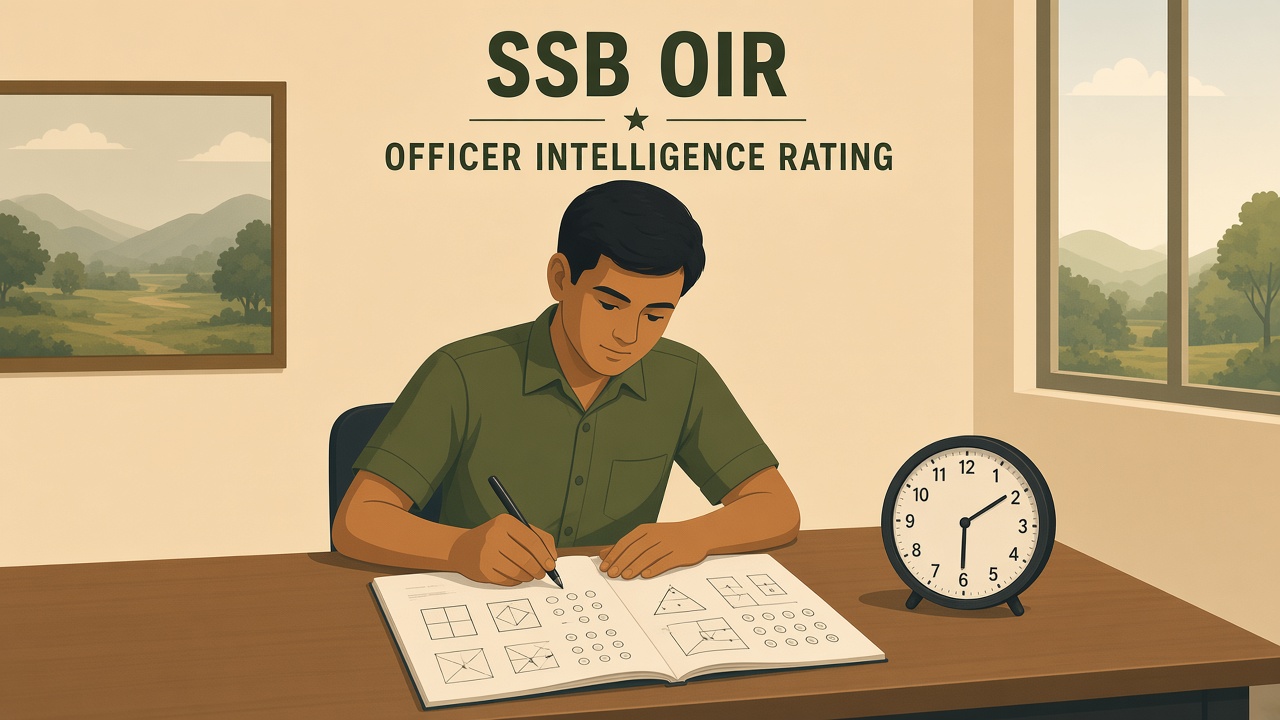
Officer Intelligence Rating (OIR) Practice
Day-1 verbal and non-verbal reasoning booklet — 40 timed questions covering analogies, series, coding, directions, figures and cubes. Practise before you sit PPDT.
Practice OIR, PPDT, TAT, WAT, SRT and the Self Description (SD) test through structured, time-bound interactive exercises designed for Indian Armed Forces SSB preparation. Read the free interview Q&A bank, Lecturette topics and screening guides, then run a timed simulator below.

Day-1 verbal and non-verbal reasoning booklet — 40 timed questions covering analogies, series, coding, directions, figures and cubes. Practise before you sit PPDT.
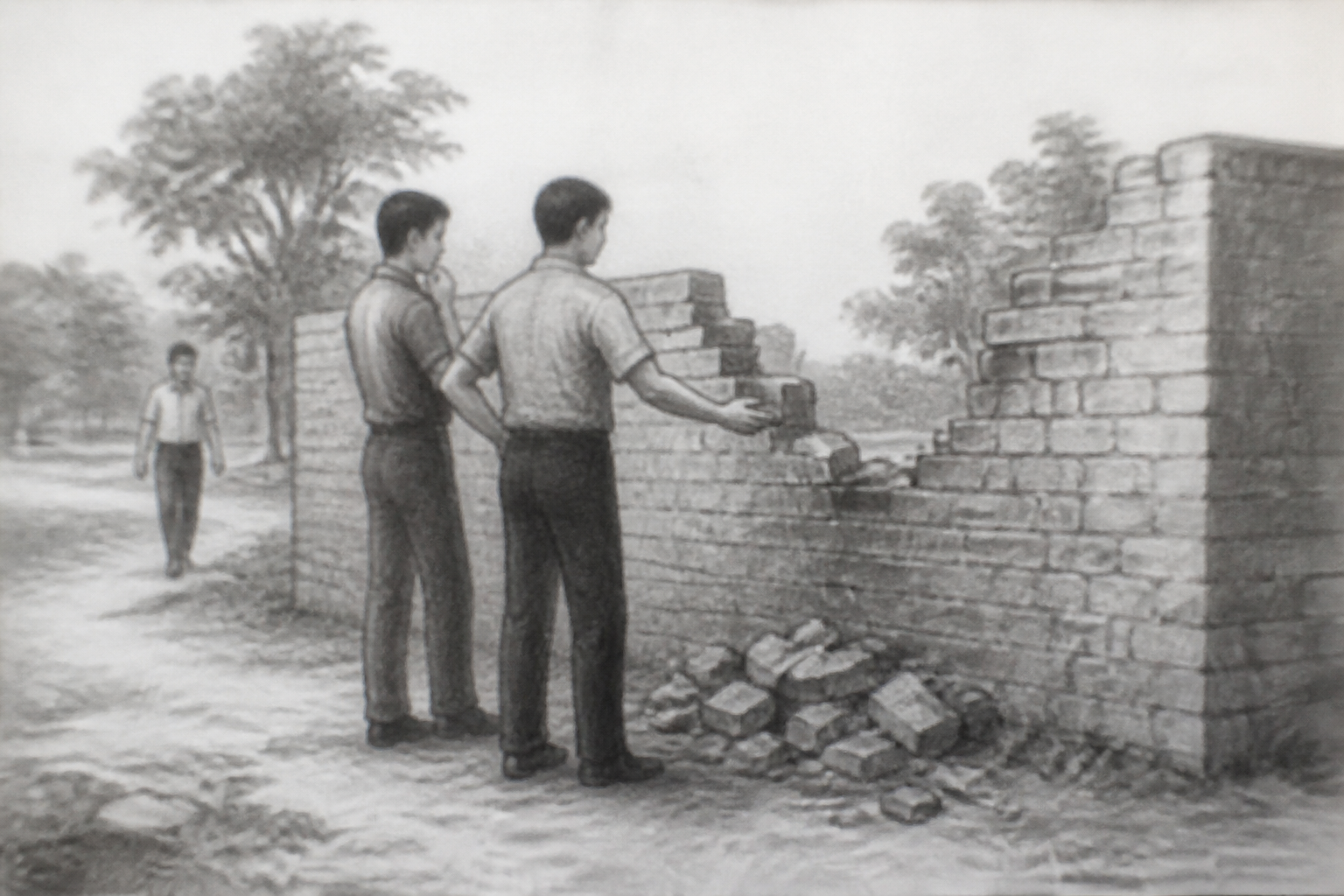
The Day-1 SSB screening test: observe one hazy picture, then write your story in 4 minutes — the same format that decides whether you're screened in for the rest of the SSB.
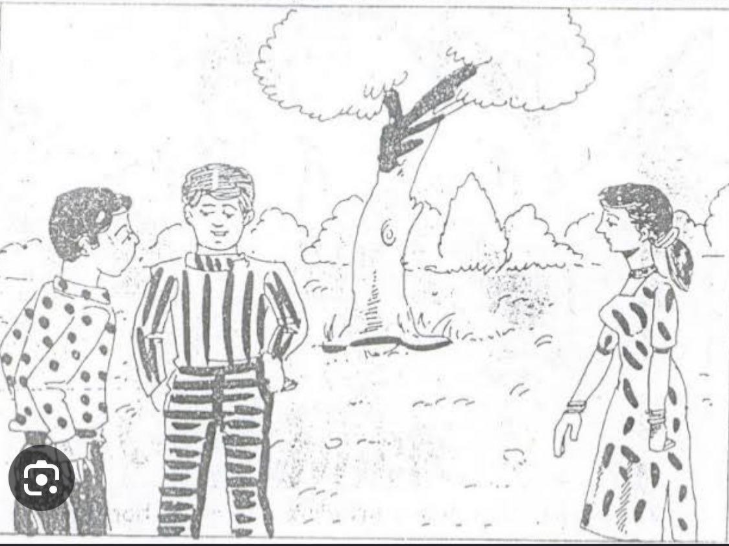
Analyze 11 ambiguous pictures + 1 blank slide to project your inner framework, desires, and constructive worldview.
Observe 60 successive words flash rapidly on-screen to measure spontaneous subconscious associations and psychological resilience.
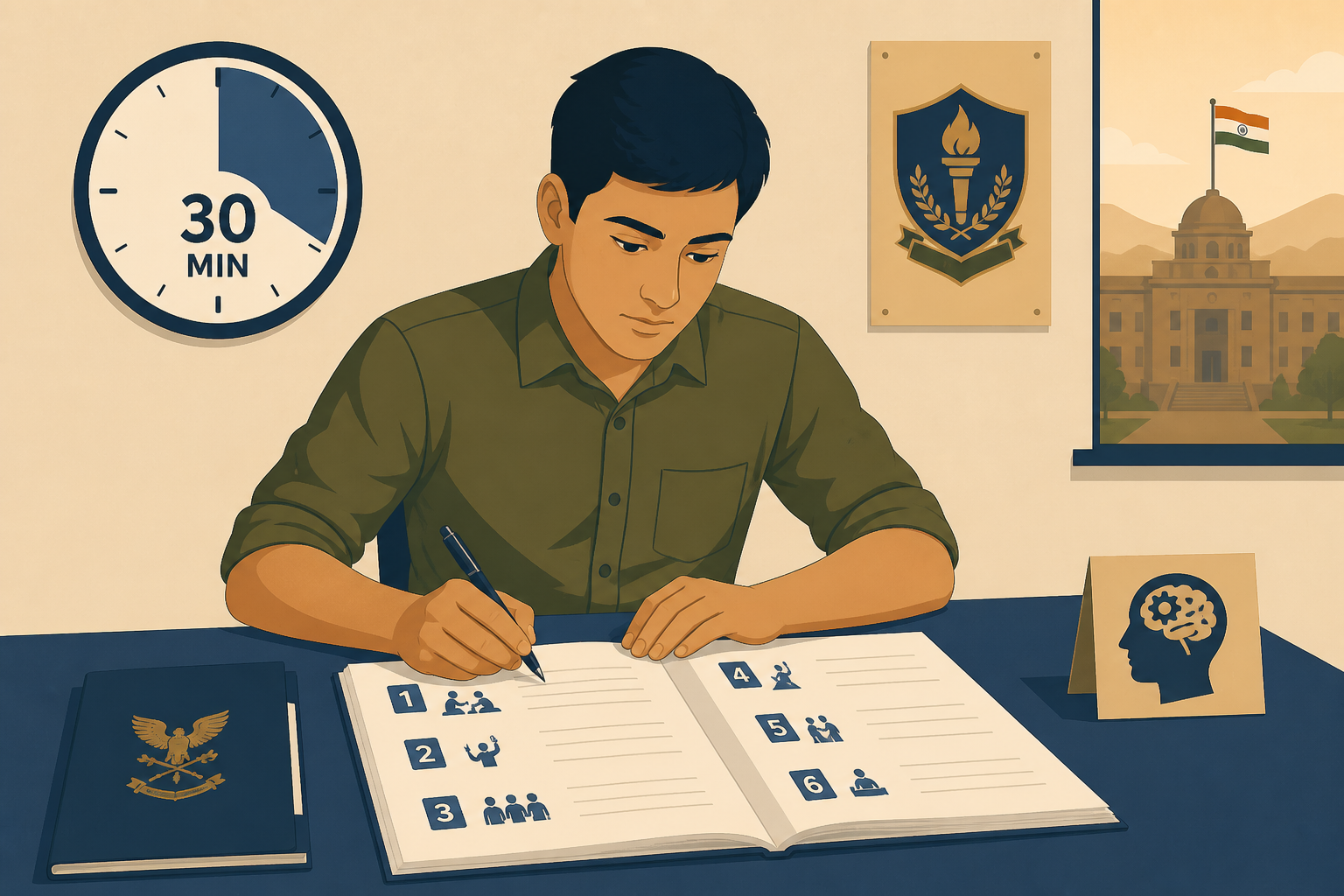
Encounter 60 real-world, high-pressure conflict scenarios printed simultaneously to test social adaptability and quick crisis resolution.
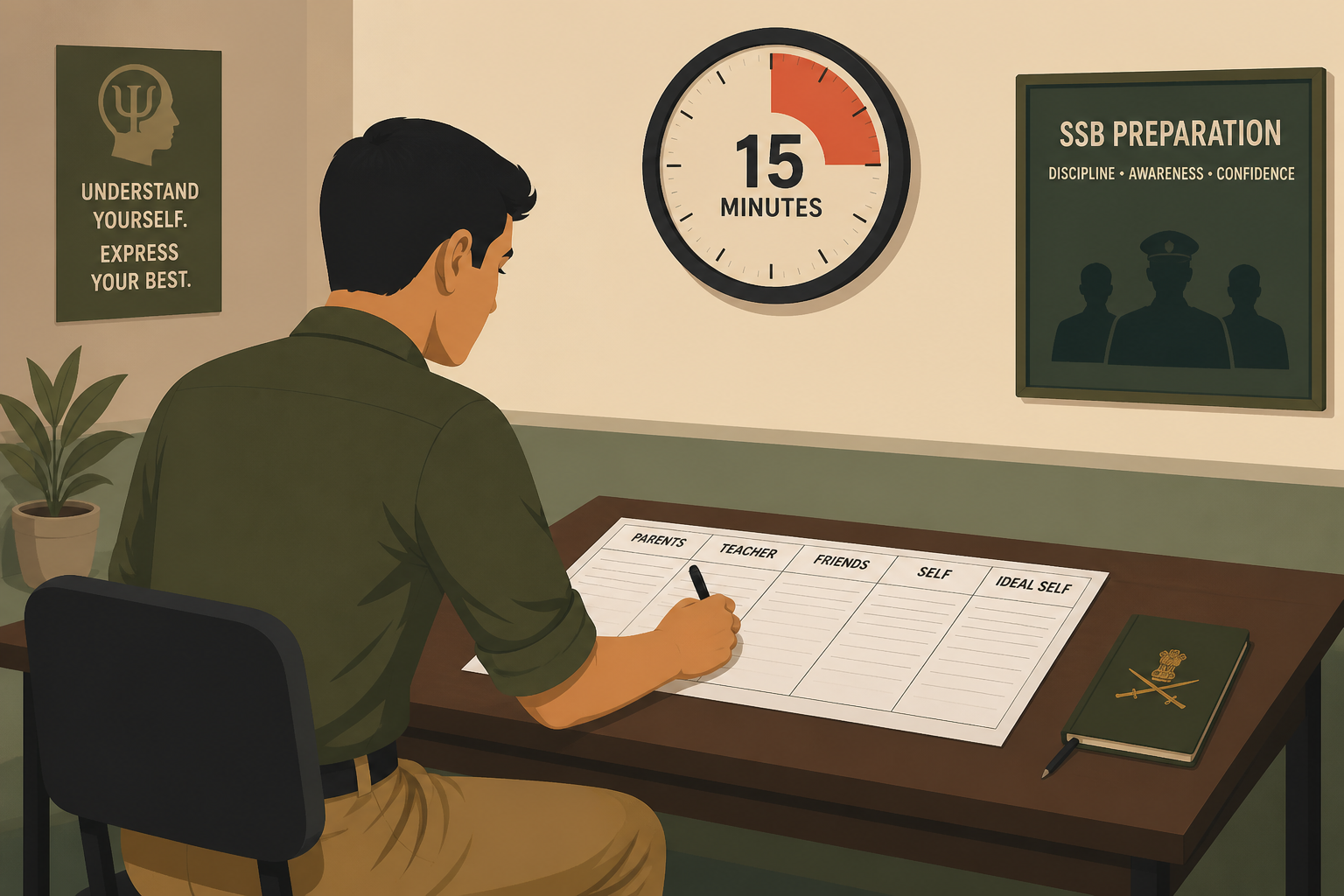
Write five short paragraphs — Parents, Teacher/Employer, Friends/Colleagues, Self as you are, Self as you would like to be — in 15 minutes. The most cross-checked psychology test at the SSB interview.
Every response you formulate across these tests projects markers for these 4 core psychological factors.
Read strategy and sample answers before you run a timed simulator — the Day-1 PPDT screening test, the Day-2 TAT / WAT / SRT / SD psychology tests, all 9 GTO tasks on Day 3 & 4, the Personal Interview question bank, and exam-choice comparisons.
Officer Intelligence Rating — 40 verbal and non-verbal reasoning questions in 30 minutes. The missing half of SSB screening next to PPDT.
New
GTO 3-minute speech bank — hook, three points and a close for defence, current affairs, social and abstract chits, plus a prep/speak timer.
New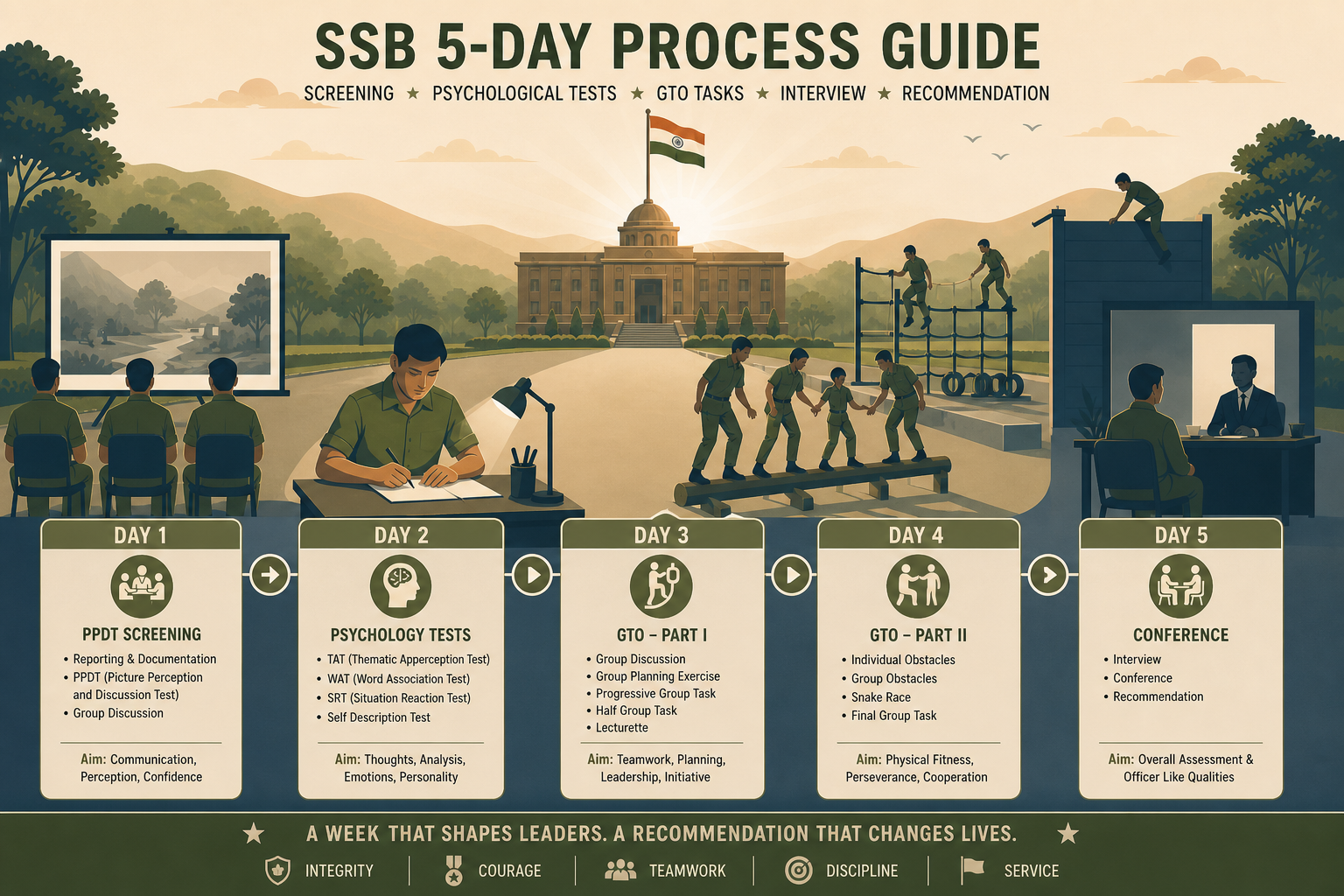
Day-by-day checklist for 28 days — PPDT narration, psychology simulators, GTO guides, PIQ and interview prep with links to every tool on ssbpractice.in.
New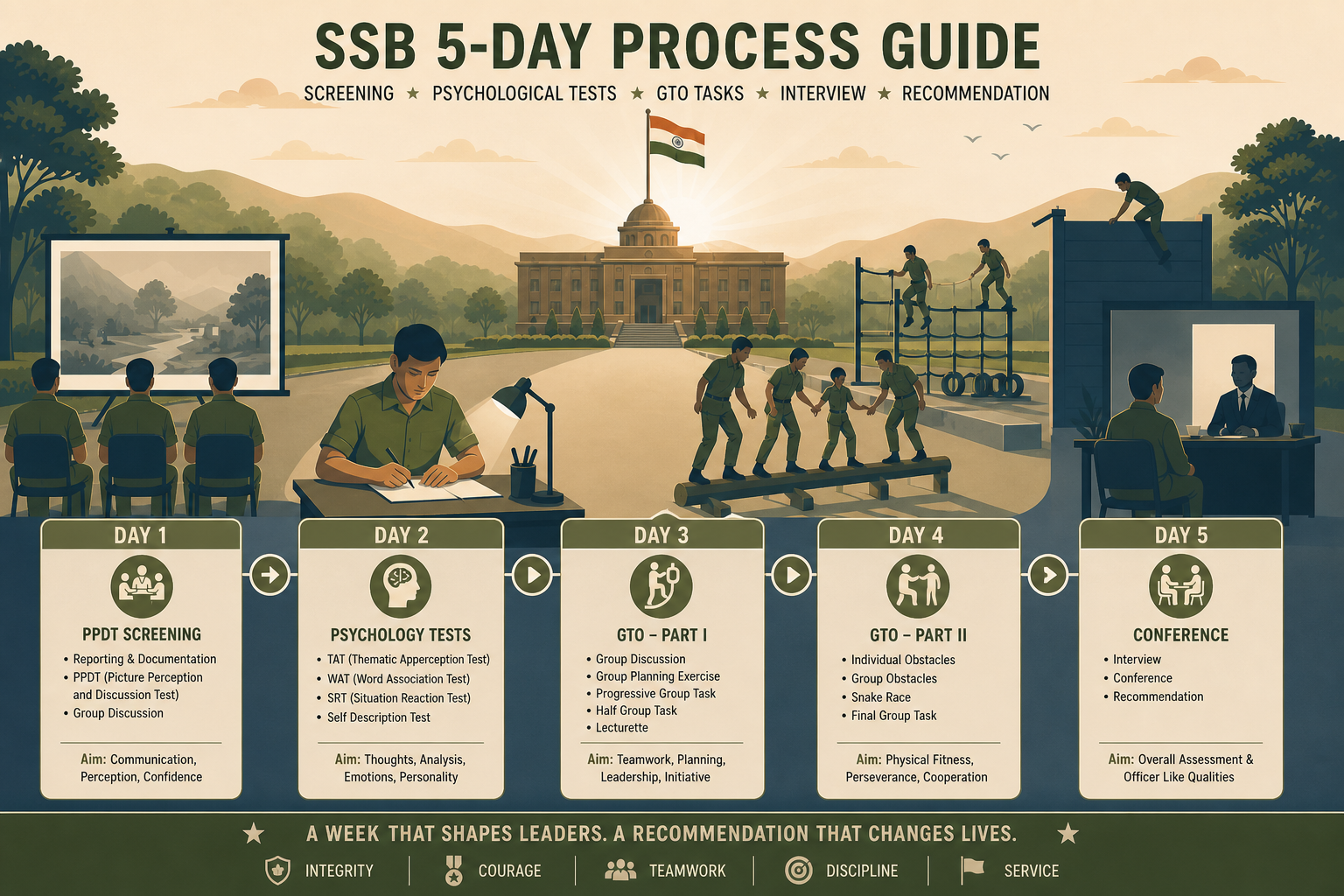
Day-by-day timeline — screening, psychology, GTO, interview, conference and medical. Know exactly what happens at the SSB before you arrive.
The 4-part story framework, common mistakes, and 5 full sample stories including the blank slide.
How to write spontaneous, action-oriented sentences in 15 seconds — with worked examples.
Character-count method, 4-part story framework, Group Discussion tips, and 4 sample PPDT stories with 1-minute narration cues.
Action-first response formula and 20 situation → response pairs across every SRT category.
15-minute plan and 5 full sample paragraphs for Parents, Teacher/Employer, Friends/Colleagues, Self as you are and Self as you would like to be.
New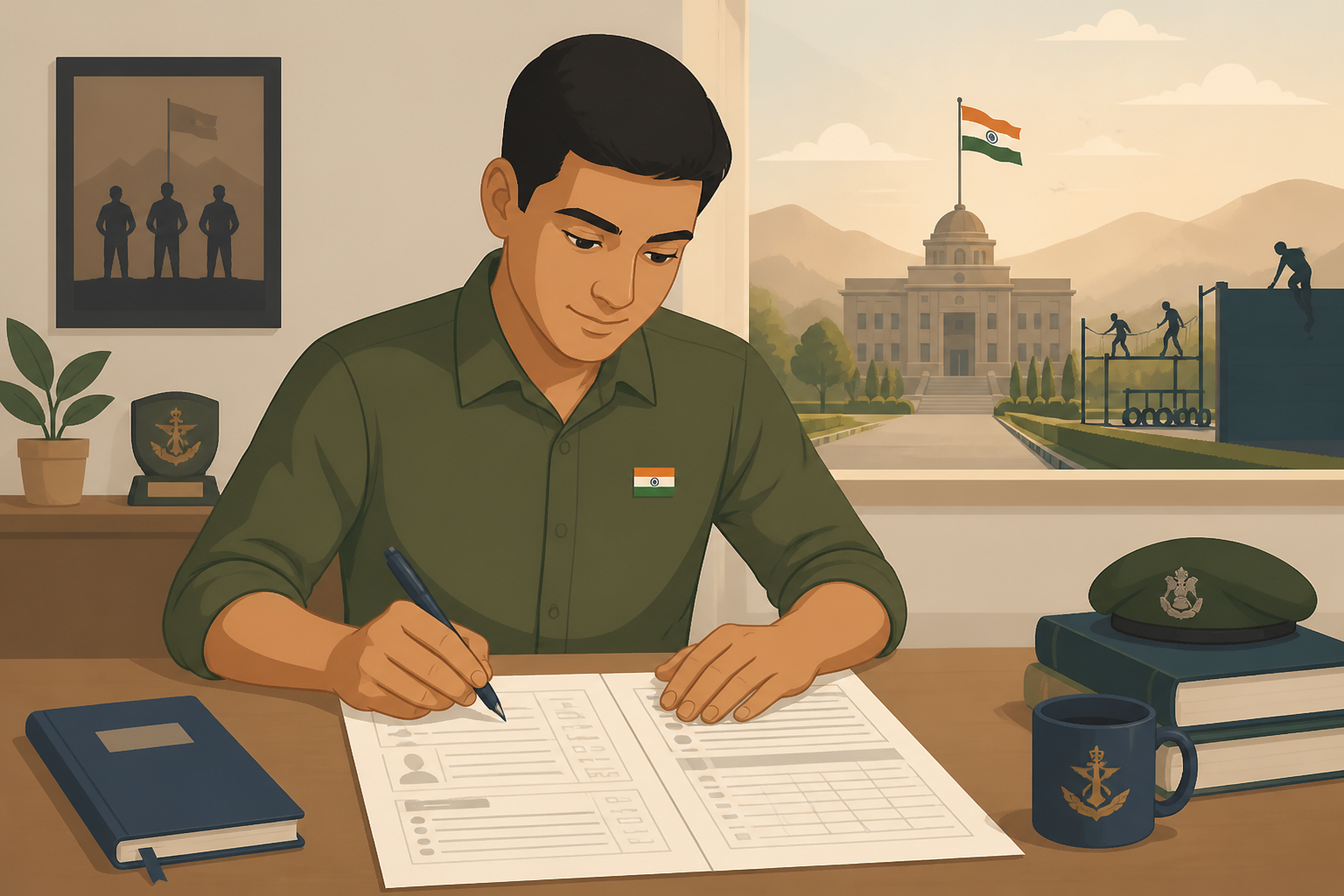
Fill your Personal Information Questionnaire online, auto-save the draft to your browser, and download a print-ready PDF to carry to your SSB interview.
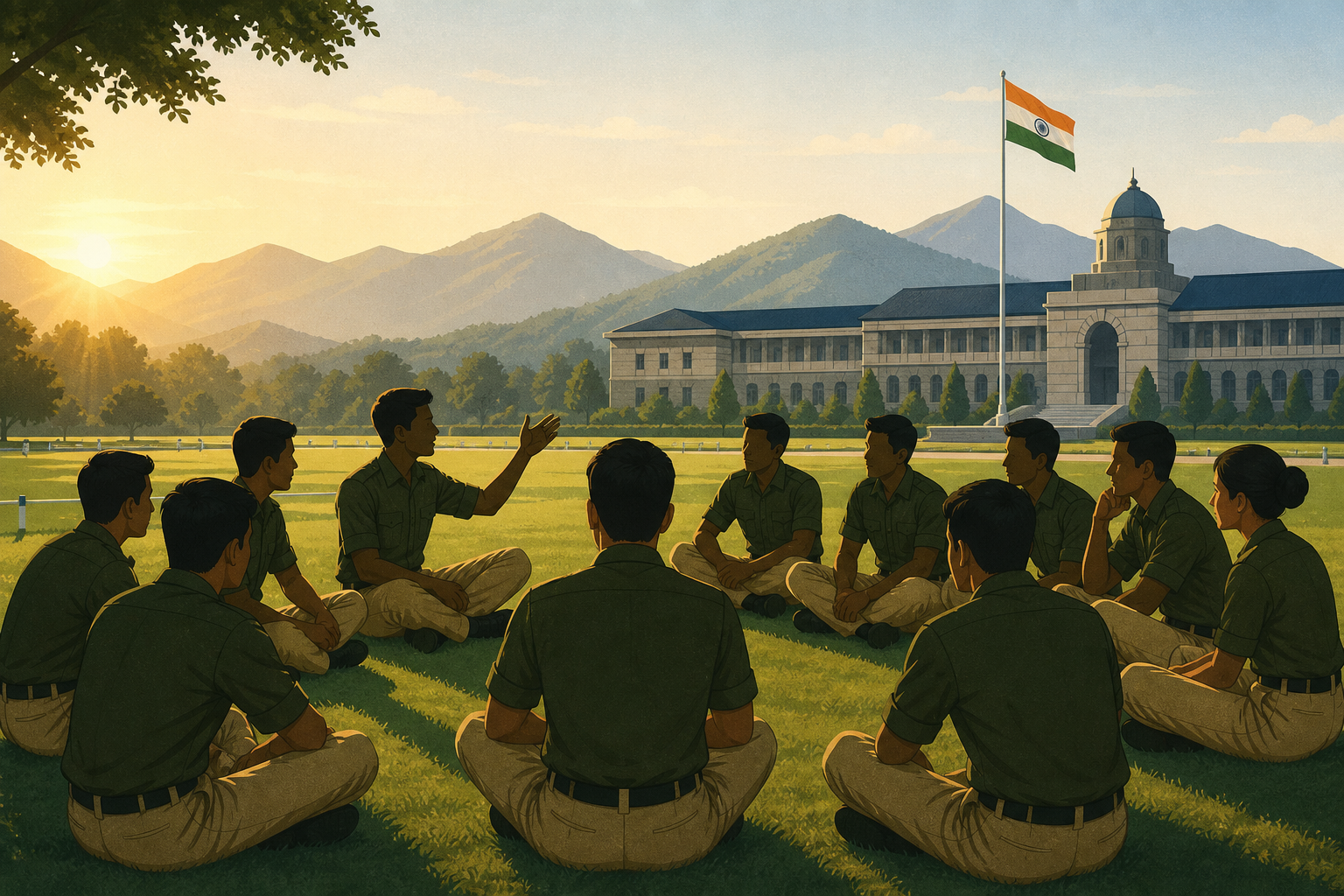
All 9 GTO tasks explained — GD, GPE, PGT, HGT, Individual Obstacles, Command Task, Snake Race, FGT and Lecturette — with format, timing, do/don't and step-by-step frameworks.
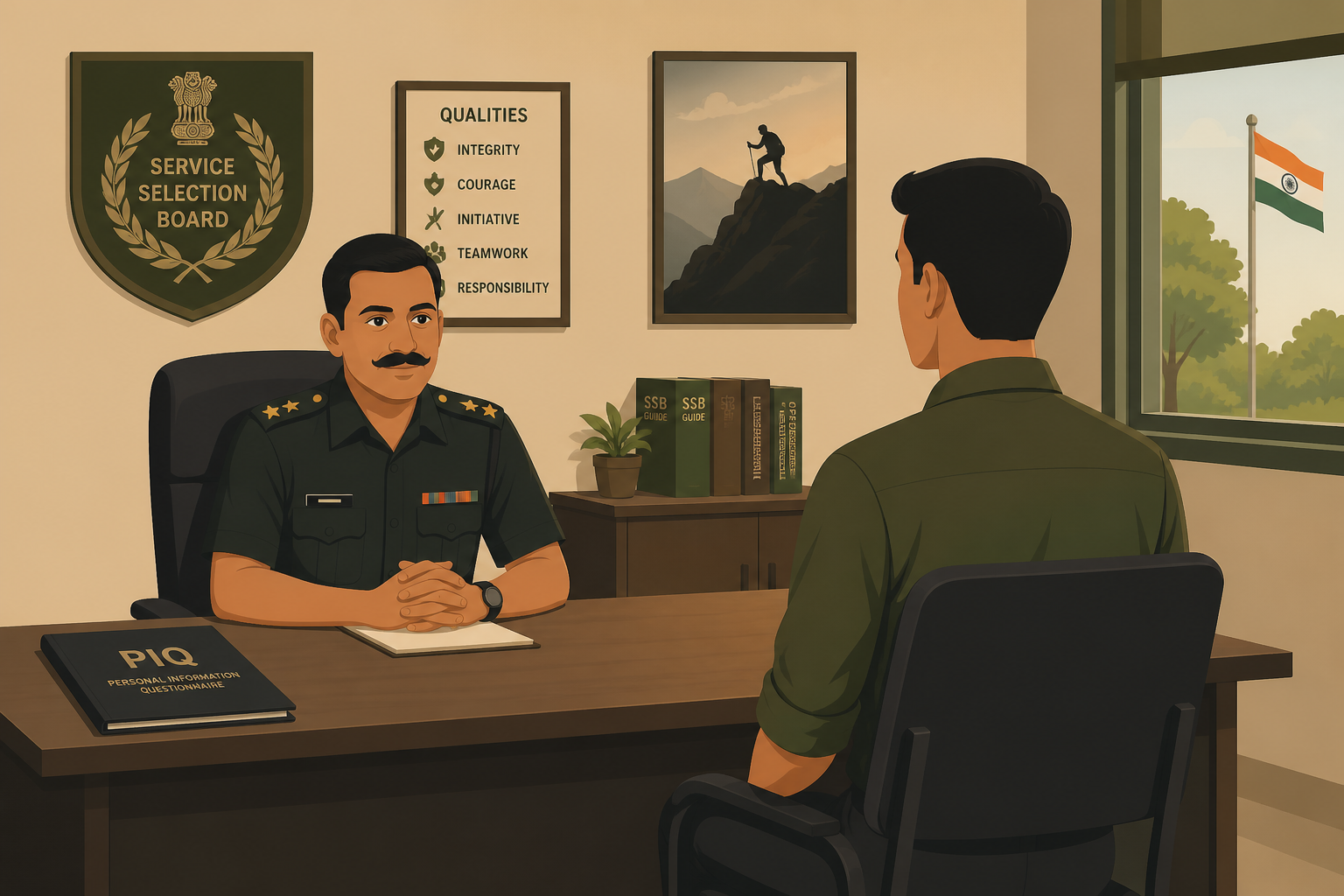
100+ Personal Interview questions with model answers — family, education, hobbies, current affairs, defence, Agnipath, gap years, women in forces, rejection and stress questions.
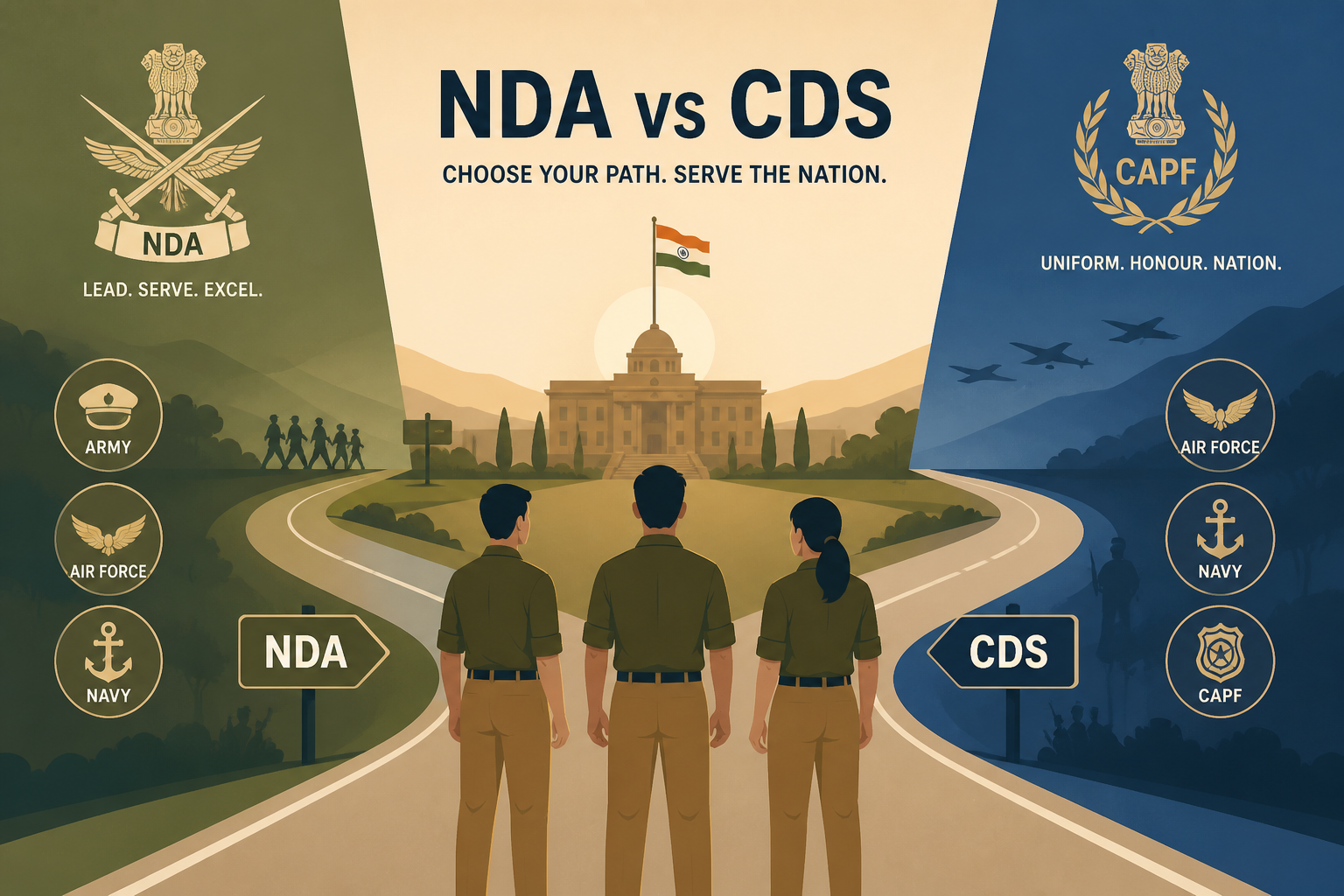
NDA vs CDS, TAT vs PPDT, AFCAT vs CDS, NDA vs TES, CDS vs CAPF, PC vs SSC, Army vs Navy vs Air Force — clear side-by-side tables, FAQs and a verdict at the end of every page.
New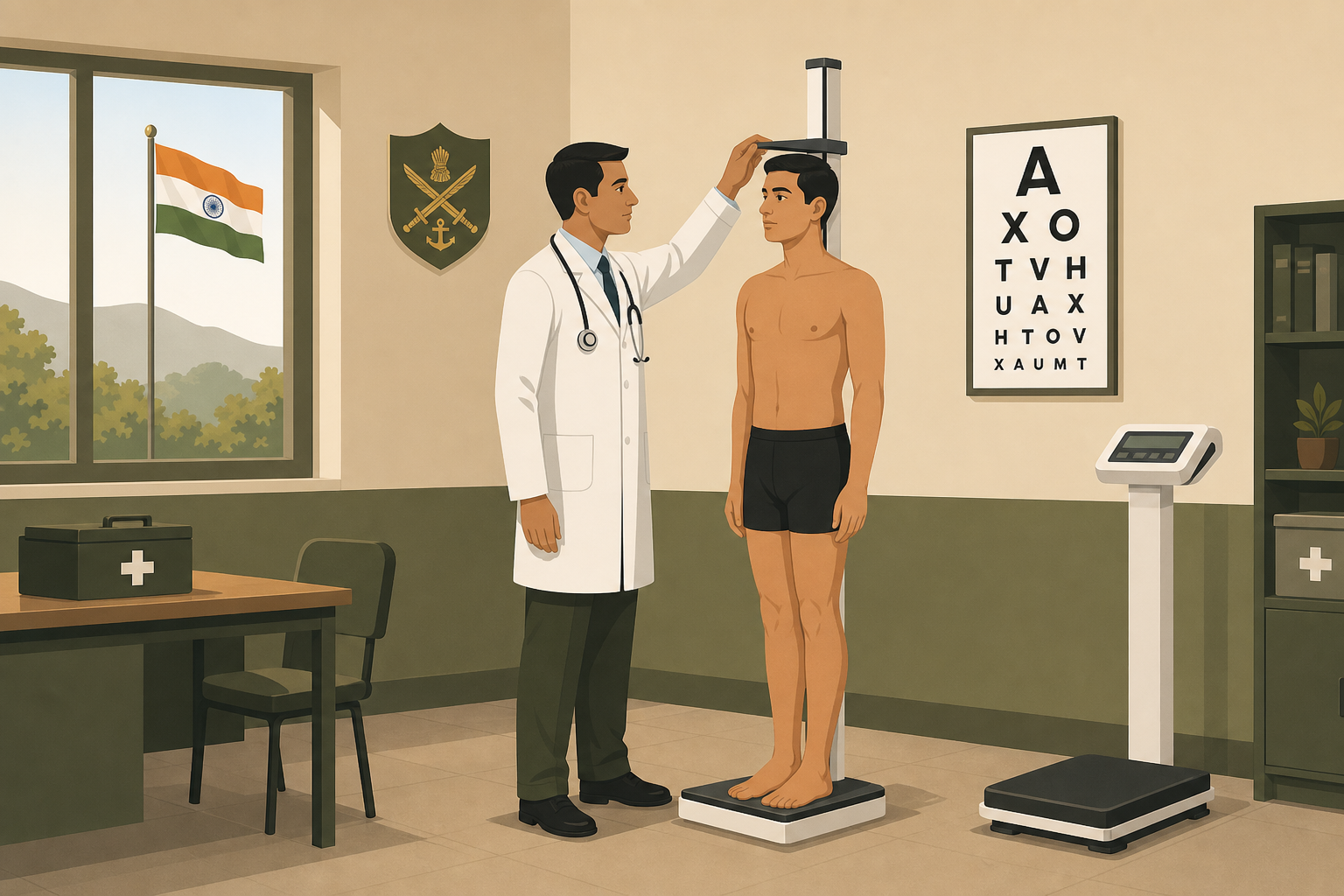
Height, weight, eyesight, dental — plus common temporary and permanent rejections (flat foot, knock knees, gynecomastia, DNS, varicocele) and the AMB / RMB appeal process.
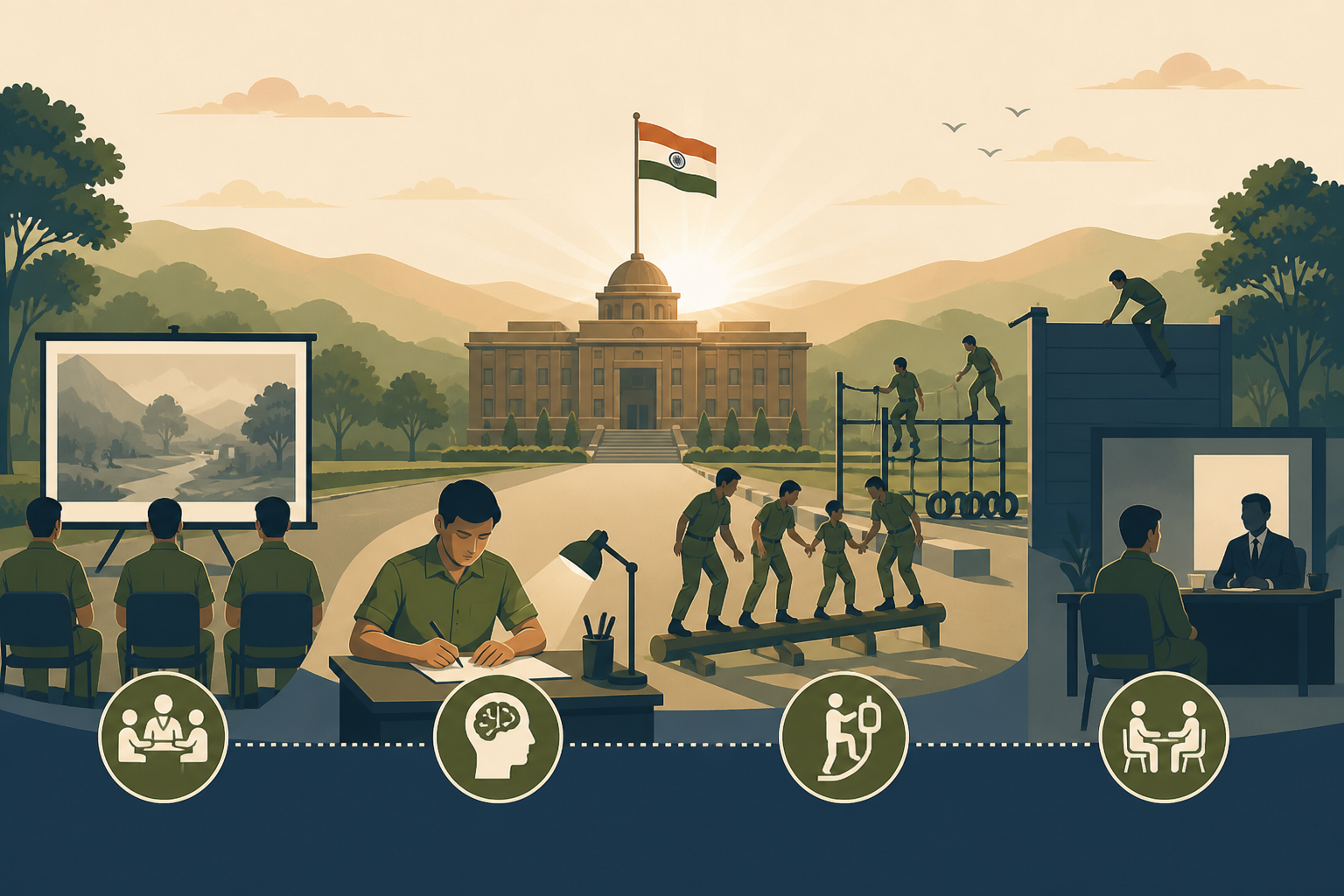
Browse the full guides hub — screening, psychology, GTO tasks and exam comparisons.
Quick answers to what aspirants ask most often about TAT, WAT, SRT and the SSB psychology round.
The Services Selection Board (SSB) interview is a 5-day personality and intelligence assessment conducted by the Indian Armed Forces to select candidates for the Army, Navy and Air Force. It is mandatory for entries such as NDA, CDS, AFCAT, TES, TGC, SSC Tech and INET.
OIR (Officer Intelligence Rating) is the verbal and non-verbal reasoning booklet on Day 1, before PPDT. A weak OIR plus a weak PPDT story is a common screen-out pair. Our free OIR simulator gives you 40 mixed questions in 30 minutes with explanations so you can practise speed before you reach the board.
Yes. Every OIR, PPDT, TAT, WAT, SRT and SD simulator on ssbpractice.in is 100% free to use, as is the Personal Interview Q&A bank and Lecturette topic outlines. There is no sign-up, no paywall and no hidden charges — just open a test and begin.
TAT (Thematic Apperception Test) shows you ambiguous pictures on which you write short stories. WAT (Word Association Test) flashes 60 words to which you write your first natural sentence. SRT (Situation Reaction Test) gives you 60 real-life situations to react to in writing within 30 minutes. All three measure your Officer Like Qualities (OLQs).
Day 1 screening starts with OIR (Officer Intelligence Rating) verbal and non-verbal reasoning booklets, then PPDT. PPDT shows one hazy picture for 30 seconds and gives you 4 minutes to write a story, followed by a Group Discussion. TAT, by contrast, is a Day-2 psychology test with 12 clearer pictures and no group discussion. OIR + PPDT + GD together decide whether you are screened in for the remaining four days of SSB.
No registration is required. Just visit ssbpractice.in on any modern browser — desktop, laptop, tablet or mobile — and start practicing immediately.
SSB Practice is useful for every defence entry that includes a Stage 2 psychology test, including NDA, CDS, AFCAT, TES, TGC, SSC Tech, INET, ACC and University Entry Scheme (UES).
PPDT is a single-picture test that takes 4 minutes 30 seconds in total — 30 seconds to observe one hazy black-and-white picture, followed by 4 minutes to write your story on paper. Immediately after, candidates form small groups for a Group Discussion where each person narrates their story and the group tries to arrive at a common story. The GD is offline and is not simulated on this website.
A standard SSB TAT shows 12 slides — 11 ambiguous pictures plus 1 intentionally blank slide. You get 30 seconds to observe each picture and 4 minutes to write the story, for a total test length of about 54 minutes.
WAT presents 60 English words, one after another. You get exactly 15 seconds per word to write your first spontaneous sentence. The full test runs for 15 minutes continuously.
SRT contains 60 real-world situations printed simultaneously on a single booklet. You have 30 minutes total to write your reactions, which works out to roughly 30 seconds per situation.
SD is the fourth Day-2 psychology test. All five prompts — how your parents, teacher/employer and friends/colleagues see you, plus what type of person you are and what type of person you want to become — are placed in front of you at the same time with a single 15-minute timer. There is no per-section cut-off; you decide the split, usually around 3 minutes per section. Our SD simulator mirrors this exactly: all 5 prompts on one screen, one continuous 15-minute countdown, and optional per-section tick-boxes to help you track your own progress.
Strict Mode replicates real SSB conditions — once the timer starts it cannot be paused. Practice Mode is meant for beginners and lets you pause the timer at any point so you can think, take notes and resume when ready.
The 15 OLQs are grouped into four factors: Planning & Intellect (Effective Intelligence, Reasoning Ability, Organizing Ability, Power of Expression), Social Adjustment (Social Adaptability, Cooperation, Sense of Responsibility), Social Effectiveness (Initiative, Self-Confidence, Speed of Decision, Ability to Influence, Liveliness) and Dynamic / Guts (Determination, Courage, Stamina).
Treat each picture as a snapshot of a real-life situation. Identify the main character (preferably close to your own age and gender), describe a clear background, a small but realistic problem, the action your hero takes, and a positive but believable outcome. Avoid heroic exaggeration, supernatural elements or political themes — write like the helpful, capable person you already are.
Write only the first natural sentence that comes to mind — never a definition, proverb, or rehearsed answer. Use the word as a subject or object in a short, action-oriented sentence that reflects a positive, practical mindset. Skip a word rather than write something dishonest if you genuinely blank out; assessors look for authenticity, not perfection on every word.
Read each situation and write the first practical action you would actually take, in 1–2 short sentences. Focus on resources at hand, calm thinking, and personal responsibility. Avoid ideal-citizen clichés ("I will call the police", "I will inform the principal") and instead show initiative — what would *you* do in the first 30 seconds before help arrives?
Writing artificial bookish answers, projecting a hero-like image, taking too long on a single TAT story, leaving WAT words blank because the "perfect" sentence didn't arrive, ignoring time limits in SRT, and using political, religious or violent themes. Practice in Strict Mode regularly to build the time discipline assessors look for.
Aim for 3–4 full simulator sessions per week in the 3–4 weeks leading up to your SSB date. Alternate between Practice Mode (to refine quality) and Strict Mode (to build speed and stamina). Review your responses after each session and identify which OLQs you projected — and which you missed.
Write in third person or first person consistently across all five sections. Back every quality with one real incident from your life. In Section 4, describe what type of person you are — include at least two honest limitations; assessors distrust candidates who claim only strengths. In Section 5, describe what type of person you want to become — keep it realistic and achievable within 2–3 years, not a fantasy ideal. Above all, every claim in SD must match your PIQ form and be defensible in the Personal Interview.
The Interviewing Officer (IO) covers 8–10 broad areas: family background, education, hobbies and sports, achievements and positions of responsibility, current affairs and defence GK, motivation for joining the forces, PIQ follow-ups, situational/behavioural scenarios and occasionally stress questions. Our Interview Q&A Bank has 100+ real questions organised by category, with model answers and "why the IO asks this" notes for every question.